
CCA vs OFC Battery Cable: What Actually Changes in Your Starter Circuit
Copper-clad aluminum vs oxygen-free copper battery cable: resistance math, why CCA needs about 2 gauge sizes larger, corrosion risks and how to spot CCA.
Two battery cables can look identical: same gauge printed on the jacket, same shiny copper at the cut end. One is solid copper. The other is copper-clad aluminum (CCA), an aluminum core with a thin copper skin. On a starter circuit that moves hundreds of amps, that difference shows up as voltage drop, heat and corrosion at the lug. Here is the engineering, with the math shown and every number sourced.
What CCA and OFC are
Copper-clad aluminum (CCA) is defined by ASTM B566 as wire with "a core of aluminum with a continuous outer cladding of copper thoroughly bonded to the core." The standard covers two grades by copper content: nominally 10% or 15% copper by volume. The rest is aluminum. [ASTM B566]
Oxygen-free copper (OFC) is defined by ASTM B170 as copper with oxygen not exceeding 0.0010% (10 ppm). Grade 2 (UNS C10200, "OF") is at least 99.95% copper. Grade 1 (C10100, "OFE") is at least 99.99% copper. [ASTM B170, Copper Development Association]
Honest note: the big electrical gap is copper vs aluminum, not OFC vs ordinary copper. Standard electrolytic tough pitch copper (C11000) is still 99.90% copper minimum. [Copper Development Association] OFC's advantages are purity and consistency. ASTM B170 requires OF grade copper to survive 8 reverse bends (OFE: 10) without breaking. [ASTM B170] CCA is a different material altogether.
Resistivity: the numbers
| Conductor | Resistivity at 20 C (ohm-cmil/ft) | Source |
|---|---|---|
| Annealed copper (IACS reference) | 10.371 | NBS Circular 31 (NIST) |
| CCA, 15% copper | 16.10 | MWS Wire engineering table, per ASTM B566 |
| CCA, 10% copper | 16.50 | MWS Wire engineering table, per ASTM B566 |
| Hard-drawn aluminum | 2.828 microhm-cm (vs copper 1.7241) | NBS Circular 31 (NIST) |
In conductivity terms, 10% CCA is 62.9% IACS and 15% CCA is 64.4% IACS. [MWS Wire, per ASTM B566]
What that means: for the same gauge, 10% CCA has 16.50 / 10.371 = 1.59 times the resistance of copper. That is 59% more resistance.
How much bigger does CCA need to be?
In the American Wire Gauge system, each step changes the diameter by a factor of 921/39 = 1.1229. [UC Santa Barbara Physics] So each gauge step changes cross-sectional area by 1.12292 = 1.261.
To match copper's resistance, CCA needs 1.59 times the area:
- ln(1.591) / ln(1.261) = 0.465 / 0.232 = 2.0 gauge steps
Worked check using the AWG formula: 2 AWG is about 66,370 circular mils and 1/0 AWG is about 105,500 circular mils.
- Copper 2 AWG: 10.371 / 66,370 = 0.156 milliohm per foot
- CCA (10%) 1/0 AWG: 16.50 / 105,500 = 0.156 milliohm per foot
So 1/0 CCA is roughly equal to 2 AWG copper in DC resistance. Building codes treat it the same way: NEMA's bulletin on the National Electrical Code gives the example of a 15 A branch circuit using 14 AWG copper or 12 AWG copper-clad aluminum, with separate ampacity columns for each. [NEMA Bulletin 122]
Voltage drop in a starter circuit (illustrative)
Delco Remy's diagnostic manual tests cranking cables at a 500 A carbon-pile load. Total loss, positive plus negative cable, shall not exceed 0.500 V for 12 V systems with 37MT, 40MT, 41MT or 42MT starters, and 0.400 V with a 50MT starter. [Delco Remy Diagnostic Procedures Manual] Their heavy-duty troubleshooting guide uses the same 500 A test and 0.5 V limit. [Delco Remy HD Troubleshooting Guide]
Illustrative example only. Conductor resistance at 20 C, 500 A, per foot of conductor. Lugs, connections and temperature rise not included. Not based on any Big7 kit.
| Conductor | Resistance per ft | Drop per ft at 500 A | Heat per ft at 500 A (I2 x R) |
|---|---|---|---|
| 2 AWG copper | 0.156 milliohm | 0.078 V | 39 W |
| 2 AWG CCA (10%) | 0.249 milliohm | 0.124 V | 62 W |
| 1/0 CCA (10%) | 0.156 milliohm | 0.078 V | 39 W |
Same gauge, CCA burns through the 0.5 V budget about 1.59 times faster and turns 59% more of the current into heat in the cable. Delco Remy notes that voltage drop is "often the cause of a slow cranking complaint" and a leading cause of click or no-click complaints, because the starter's control circuit is fed from the heavy positive post. [Delco Remy Tech Tip]
Corrosion at the lug
A battery cable is only as good as its terminations. When you crimp CCA, the cut end exposes the aluminum core inside a copper lug.
- Galvanic corrosion: NASA describes galvanic corrosion as "an electrochemical action of two dissimilar metals in the presence of an electrolyte." In its galvanic series, aluminum sits on the active side of copper, so aluminum is the metal that corrodes. [NASA Kennedy Space Center Corrosion Technology Lab] Under the hood, road salt and moisture supply the electrolyte.
- High-resistance junctions: a NIST study of aluminum wiring connections found copper-aluminum intermetallic compounds such as CuAl2 forming at overheated interfaces, with resistivity on the order of 100 x 10-6 ohm-cm or higher, enough to cause significant I2R heating at the joint. [NIST, Journal of Research] The CPSC describes aluminum connection deterioration as "cumulative in effect." [CPSC Pub. 516]
Those NIST and CPSC findings come from residential aluminum wiring, not vehicles. The mechanisms (loosening, heat cycling, high-resistance joints) are the same ones a crimped lug sees, with more vibration and heat cycling.
The marine standard is blunt about it: ABYC E-11 requires that boat conductors "shall be stranded copper." [ABYC E-11 excerpt]
Heat and loosening
More resistance means more I2R heat (table above). The NIST study lists expansion and contraction from I2R heating as a principal cause of loose aluminum connections. [NIST, Journal of Research] Under the hood, every start is a heat cycle.
Why SAE J1127 matters, and what it does not tell you
SAE J1127 is the SAE standard for low-voltage battery cable, covering cable for systems of 60 VDC (25 VAC) or less in surface vehicles. Its tests "qualify cables for normal applications with limited exposure to fluids and physical abuse." [SAE J1127_202508] It sets the insulation, temperature and durability bar for battery cable.
What it does not do, according to wire-testing lab Lectromec's review, is require a specific conductor substrate: "there is not a specific requirement in the J1127 and J1128 specifications that the conductor substrate be a specific material/alloy." [Lectromec] So "SAE J1127" on a jacket tells you the cable passed SAE's battery cable tests. It does not by itself tell you the conductor is solid copper. Ask for both: SAE J1127 and an all-copper conductor.
How to spot CCA
- Cut or scrape test. CCA is an aluminum core with copper cladding (ASTM B566). Scrape or cut a strand end and look for a silver-gray center under the copper.
- Weight. 10% CCA weighs 0.120 lb/in3 [MWS Wire] vs copper's 8.89 g/cm3, which converts to 0.321 lb/in3 [NBS Circular 31], so CCA is about 37% of the weight of copper at the same size. A spool or cable that feels too light for its gauge is a warning sign.
- Magnet: does not help. CCA is non-magnetic, so a magnet will not flag it. (Copper-clad steel is magnetic, which is a different product.) [MWS Wire]
- Jacket print. Look for "CCA," "copper clad" or "Cu-clad Al." If the print gives a gauge but never names the conductor metal, ask.
- Price. If a cable costs far less than copper cable of the same gauge, ask what the conductor is.
FAQ
Is CCA battery cable OK for a car or truck? CCA has about 1.59 times the resistance of copper at the same gauge, and its aluminum core is exposed to galvanic corrosion and connection deterioration at the lug. On a high-current starter circuit, copper is the safer choice.
How much bigger does CCA cable need to be? About 2 AWG sizes larger to match copper's DC resistance. For example, 1/0 CCA is roughly equal to 2 AWG copper.
How can I tell if my battery cable is CCA? Scrape or cut a strand and look for a silver aluminum center. CCA is also much lighter than copper. A magnet will not tell them apart.
Is OFC better than regular copper? OFC (ASTM B170) is at least 99.95% copper with no more than 10 ppm oxygen. Ordinary electrolytic copper is at least 99.90% copper. Both conduct far better than CCA. The bigger choice is copper vs CCA.
Does "SAE J1127" mean the cable is solid copper? Not by itself. SAE J1127 is the SAE battery cable standard, but it does not specify the conductor material. Look for SAE J1127 and an all-copper conductor.
How much voltage drop is acceptable in a starter circuit? Delco Remy specifies no more than 0.500 V total (positive plus negative cable) at 500 A for 12 V systems with 37MT to 42MT starters, and 0.400 V for the 50MT.
How Big7 builds its kits
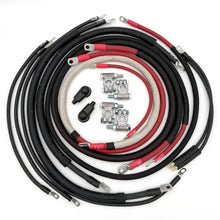
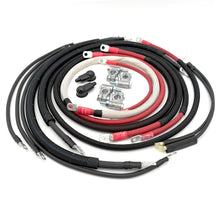
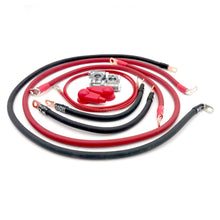
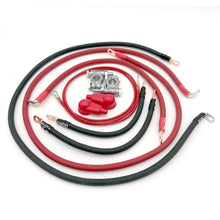
Big7 kits use American-made SAE J1127 fine-stranded oxygen-free copper battery cable with EPDM insulation rated 105 C. Each end gets a tin-plated copper lug with a gas-tight crimp rated at 700 lbs of pull force, sealed with marine-grade dual-wall adhesive-lined heat shrink. Kits are built in Vancouver, WA.
Find the kit for your vehicle: all Big 7 battery cable kits | Jeep | Ford | Diesel | Dodge/Ram | Chevrolet/GMC | Toyota
References
- ASTM B566, Standard Specification for Copper-Clad Aluminum Wire
- ASTM B170, Oxygen-Free Electrolytic Copper
- Copper Development Association, Wrought Coppers data sheet
- NBS (now NIST) Circular 31, Copper Wire Tables
- MWS Wire Industries, Copper Clad Aluminum and Other Clad Metals
- UC Santa Barbara Physics, American Wire Gauge
- NEMA Bulletin 122, Copper-Clad Aluminum Conductor Requirements in the NEC
- Delco Remy, Diagnostic Procedures Manual
- Delco Remy, Heavy-Duty Troubleshooting Guide
- Delco Remy, Tech Tip: Diagnosing Starter Cranking Problems
- NASA KSC Corrosion Technology Laboratory, Forms of Corrosion
- NIST, Observations on the Mechanisms of High Resistance Junction Formation in Aluminum Wire Connections
- U.S. CPSC, Repairing Aluminum Wiring (Pub. 516)
- ABYC E-11, AC and DC Electrical Systems on Boats (excerpt)
- SAE J1127_202508, Low Voltage Battery Cable
- Lectromec, SAE J1127 and J1128: Battery Cable and Primary Wire Specifications